aims-and-scope
ENGINEERING & TECHNOLOGY JOURNALAims & Scope
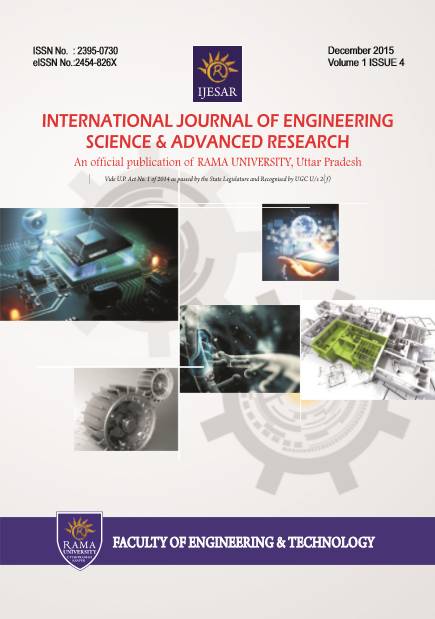
The International Journal of Engineering Science & Advanced Research (IJESAR) is a quarterly publication with Print ISSN: 2395-0730 and e-ISSN: 2454-826X, published by the Faculty of Engineering, Rama University, Kanpur. The journal has been in continuous publication since 2015.
IJESAR is a double-blind peer-reviewed, open-access international journal dedicated to publishing high-quality original research papers, review articles, and monographs in the fields of engineering, science, technology, and their applications. The journal serves as a platform for the dissemination of innovative research findings, experimental investigations, and theoretical advancements, thereby promoting scholarly contributions and academic excellence.
The journal covers a broad spectrum of engineering disciplines, with a primary focus on Computer Science & Engineering, Information Technology, Electronics & Communication Engineering, Electrical & Electronics Engineering, Civil Engineering, Mechanical Engineering, Biotechnology, and Agricultural Engineering, along with interdisciplinary areas of engineering and science.
The major subject areas covered by the journal include, but are not limited to, the following:
- Cryptography
- Application in Machine Learning
- Optimization Technique
- Graph Theory
- Environmental Chemistry
- Analytical Chemistry
- Micro-plastic
- Bio-Science and Bio-Technology
- Computational Biology
- Bio Process Engineering
- Molecular Diagnostics
- Cloud Computing and Applications
- Computer Vision
- Computer Science and Its Applications
- Quantum Technology
- Computational Techniques in Civil Engineering
- Building Materials, Concrete & Construction Technology
- Environmental Science & Engineering
- Structural Engineering & Foundation Engineering
- Transportation Engineering
- Control and Automation
- CAD/CAM/CIM
- Tribology
- Bio-Mechanics
- Production Engineering
- Additive Manufacturing
- Robotics
- Smart Power Grid
- Material Science and Engineering
- Database Theory and Applications
- Database Management System
- Data Mining
- Decision Making
- Mechanical Design
- Microfluidics & Biofluidics
- Metal Matrix Composite
- Fracture Mechanics
- Industrial Engineering & Supply Chain Management
- Vibration
- Fuzzy Logic
- Image Analysis and Processing
- Information and Data Security
- Internet Technologies, Infrastructure, Services & Applications
- Nanotechnology
- Mobile Computing and Applications
- Multimedia Communications
- Pattern Recognition
- Soft Computing
- Speech Interface & Speech Processing
- Thermal Engineering
- Ubiquitous Multimedia Computing
- Vision-Based Applications
- VLSI
- Web Technologies
- Flexible Electronics
- IoT (Internet of Things)
- Wireless Communication
Author Guidelines
Manuscript Format and Structure
Presentation:
The presentation must be precise and should include case reports, original research, or reviews. Titles, abstracts, and main text should be written in language readily intelligible to Engineering & Technology. Use times new roman font with one-line spacing with a font size of 12.
Abbreviations/Acronyms:
Use of abbreviations should be kept to a minimum, particularly those that are not standard. Terms and names referred to as abbreviations or acronyms should be written out when first used with the abbreviation in parenthesis. Do not use abbreviations in the abstract. Standard units of measurement need not be spelled out.
Structure:
Include a title page, Abstract, Key Words (List up to 6 key words needs to be mentioned), main text, References, Acknowledgments, and tables, figures, and legends as appropriate.
Title Page:
Include the title of the article and the full name and address of every author in first page file. Do not use author names in the main text. Provide the address, contact number, and email address of the corresponding author.
Tables and Figures:
Illustrations and tables should be numbered and cited in the text in order of appearance and grouped at the end of the text. Although low-quality images may be adequate for review purposes, print publication requires high quality images. Submit TIFF/JPEG files only. Images should be of 300 dpi resolution.
Figure Legends:
Figure legends should begin with a brief title for the whole figure and continue with a short description of each panel and the symbols used.
Reference List:
Literature references in the text should be cited using superscript numbers (after punctuation) in order of appearance, and correspond to the numbered reference list. All references cited in the text must be listed at the end of the paper. Do not include unpublished data or personal communications in the reference list.
Manuscript Types:
All articles should be relevant to all Engineers related disciplines and addressed to the Engineering & Technology
Topic Review and Systematic Review Articles:
The review can be a topic review or systematic review. It should cover a topic of interest for the general Engineering, Science & Technology. Reviews should offer a broad view of the field. The review Abstract should have not more than 250 words and include: Objectives, Data Sources, and Conclusion. The main text should be divided into Introduction, Data Sources, Resources Selection, Review, Discussion, and Conclusion. Search strategies must be described and the use of evidence-based systematic approaches is expected. The Discussion and Conclusion should address the relevance to the general practitioner and should be supported with relevant photographs.
Original Scientific Articles:
Original scientific articles must reach the highest international standards in the field and should be relevant to Engineering practice. The articles should describe significant and original experimental observations and provide sufficient details so that the observations can be critically evaluated and, if necessary, repeated. The article Abstract should be no more than 250 words giving details of what was done, using the following structure: Objectives: A clear statement of the main goal of the study and any tested hypotheses. Method and Materials: Describe the methods, study design, and data analysis. Results: Main results of the study, including the outcome of any statistical analysis. Conclusion: State the major conclusions of the study and their implications and relevance to the practice of Engineering.
The main text should include Introduction, Method and Materials, Results, Discussion, and Conclusion sections. The Introduction should summarize the background of the research objectives and should emphasize the relevance of the study to the practice of Engineering. The Method and Materials section must contain sufficient detail such that, in combination with the references cited, all Engineering trials and experiments reported can be fully reproduced. Manufacturers of materials should be named, known methods should be referenced, and data analysis should be described. The Results section should be presented in a logical sequence in the text, tables, and illustrations. The Discussion section should include association to previous studies, and implications of the findings to the Engineering applications should be included. The Conclusion section should not summarize the findings. Instead, the conclusions should relate to the aims of the study and the relevance to Engineering application. The conclusions should be supported by the data.
Case Reports Articles:
Case reports should include:
Abstract, Introduction, Case Presentation, Discussion, and Conclusion/ Recommendation when necessary. The Abstract should have not more than 250 words and summarize the case. The article should emphasize the new information provided and the relevance to general practitioners. Sufficient follow-up period is required, and high-quality images should be included.
Short communication:
These should be used for interesting but simpler cases, which the authors would like to share with the readers. The abstract is not mandatory and the main text is limited to 1000 words. appropriate references should be included.